
AKT in 24h News
An article in 24h magazine shared the unique perspectives of interpreter Khang Nguyen on the language industry in general and translation/interpretation specifically. In this feature, he reveals that interpretation is not the "walk in the park", but rather a profession requiring substantial passion to sustain a long career.
"Mastering a language means living an extra life”, opening diverse opportunities across multiple fields for those who master it. Let's hear interpreter Khang Nguyen share his keys to success in language mastery and his experiences in the interpretation profession.
Interpreter Khang Nguyen: Passion is the Key to Success in Language Professions
Thanks to his impressive accomplishments in the field of interpretation, Khang Nguyen’s insights on language and the art of translation have garnered significant attention, particularly his effective methods for learning English based on the perspective of an interpreter.
With an unwavering passion for languages and translation, Khang Nguyen has built an impressive track record over more than 20 years in the industry: successfully interpreting over 3,000 events and accumulating more than 20,000 hours with over 25,000 speakers. He has distilled his knowledge and real-world experiences into the English learning programs at the AKT Translation and Interpretation Training Center, which he founded. Additionally, Khang Nguyen is a familiar face as a bilingual interpreter and MC/ host at numerous prestigious conferences, solidifying his reputation within Vietnam’s translation community.
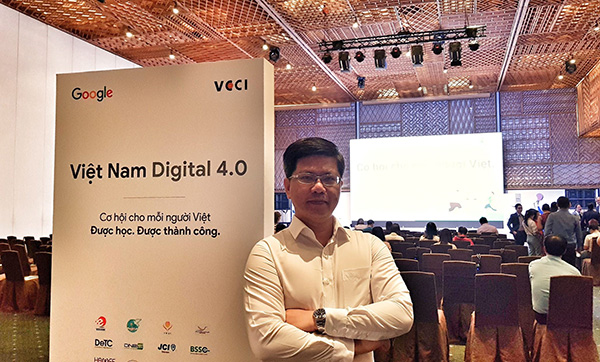
Khang Nguyen engaged in a conversation, offering perspectives and advice to young people passionate about the field of the English language and translation in particular.

Interviewer: Mr. Nguyen, interpretation has become a sought-after profession. Can you elaborate on the nature of this work to provide clarity for young people considering this career path?
Khang Nguyen: We are living in an era of globalization, where the need for connection and understanding between nations has never been more crucial. As a result, interpretation has emerged as an essential service for individuals and organizations alike. Broadly, we can categorize translation into two forms: interpretation (spoken language) and written translation. Interpretation can be further divided into simultaneous interpreting (where the interpreter translates in real-time) and consecutive interpreting (where translation occurs after a sentence or segment). On the other hand, written translation entails converting the language of written texts. From my experience as both an interpreter and an English instructor, each form of translation comes with its own challenges. Written translation demands high accuracy in vocabulary and grammar, while oral interpretation places intense pressure on speed and quick reasoning.
Thus, it is far from the common misconception that interpreters enjoy a "low-effort, high-pay" profession. To pursue a career in interpretation, one must possess a genuine passion, as passion truly is the key to success.
Interviewer: Many believe that advances in technology and translation software might render human interpreters obsolete. What is your take on this issue? Do you think technology could replace interpreters?
Khang Nguyen: At this point, I find that even the most advanced technology still primarily delivers translations based on the order of words and phrases, often adhering to grammatical rules but faltering on clarity of meaning in many areas. A trained interpreter, however, has the ability to identify these discrepancies and rectify them to produce a polished translation that captures both grammar and nuance, thereby enhancing the communicative power of both spoken and written texts. Good interpretation goes beyond merely translating words accurately; it must also fit the context and tone of the text. For instance, language used in a business meeting needs to be precise and succinct, while interpretation in a tourism context may allow for more flexibility and warmth depending on the atmosphere. This is something I always emphasize to my students.
Interviewer: How do you assess the language skills of English learners in Vietnam? What should young people prepare for in order to have successful careers in the English language field?
Khang Nguyen: Mastering a language means living an extra life. It opens up numerous opportunities and broadens perspectives far beyond what one might think. In addition to the goal of becoming an interpreter, those proficient in English can excel in myriad roles across various sectors. Today, every organization has a need to connect with the global community and engage in international trade. However, simply learning everyday conversational English holds little practical value; instead, ing interpretation skills yields immediate, tangible benefits. Most of my students are not solely focused on becoming interpreters; rather, around 80% learn to enhance their current roles or prepare for future jobs.
Interpretation training equips students with the ability to focus on key content, take relevant notes, process information swiftly, develop voice skills, adopt effective self-learning methods, and enhance presentation abilities. This empowers them to articulate ideas in diverse, exceptional ways.
For young people aspiring to become interpreters, three fundamental things to prepare for are: knowledge, skills, and attitude towards the profession. Knowledge serves as the foundation; no matter how passionate you are, lacking this can lead to failure. Skills enable you to apply knowledge in practical scenarios. Both of these aspects are teachable, and I strive to ensure my students understand them. Yet, the attitude factor is one that cannot be influenced by anyone but oneself.
Interviewer: Your AKT Translation and Interpretation Training Center is known for inspiring many young interpreters. What are your future plans to further develop this passion for the profession?
Khang Nguyen: My primary goal is to continue enhancing the training quality at AKT training. The interpretation field demands daily updates; incorporating new and optimal approaches into our curriculum ensures that our students meet societal needs and develop skills aligned with real-world applications.

Additionally, I am developing the YouTube channel "Phien Dich Vien by AKT - Interpreter Vietnam," giving students afar or those with challenging circumstances the opportunity to explore and pursue their passion for the profession. Beyond my passion for interpretation, I have also discovered a deep love for teaching. Sharing knowledge with my students rejuvenates me and inspires continuous growth alongside them.
Thank you for your insights! May I wish you continued success as a bridge-builder in the world of language.
===========================
Book AKT’s seasoned interpreters for your events or contact for more information via
- Hotline: 0888170069
- Email: info@phiendichvien.com
- Facebook fanpage: Phien Dich Vien by AKT
>> Watch our latest events on Youtube: Phien Dich Vien by AKT

-
 Specialist InterpretingView MoreAs senior managers, we know what attributes our clients are looking for in an interpreter – a good translator with expertise who can process ideas from one language to another professionally. A strong interpreter adds value to any event.
 -
 TranslationView MoreOver the years, we have worked with thousands of high-profile customers, many of whom are impressed by our excellent services.
 -
 MCView MoreBilingual MCs/Hosts are often required at international events. Our bilingual MCs all speak in a refined manner, have skills in interpreting and can amaze audiences with their confidence.
 -
 TrainingView MoreThe way we teach is characterized by putting trainees at the forefront of the learning process. Our curriculum is open to adaptability and development of personal skills in an approach best described as "From conferences to classrooms".