
Two-Way Zoom Interpretation: One Question Says It All
Author: Khang Nguyen
Khang Nguyen AKT - English Vietnamese Lead interpreter, 25 years in 5000 events
Two-way Zoom interpretation is the setup used when a remote speaker and an in-room audience hold a live Q&A in two languages, which requires Zoom's interpretation feature with separate language channels. This article shares an HCMC workshop co-hosted by the Department of Construction and UNDP, what it covered, where the interpreting challenges lay, and common questions.
Jump to: The story · What it covered · Interpreter's choices · FAQ
Interpreting for an HCMC Department of Construction–UNDP Workshop: When the Speaker Is on Zoom
"If both sides speak on the same channel, how does anyone hear anyone?" That is the one question I ask every client who wants a remote speaker on Zoom. It usually ends the discussion before I need a diagram.
At a technical workshop on low-emission personal vehicles co-hosted by the HCMC Department of Construction and UNDP, around 80 delegates from ministries, industry associations, research institutes and businesses filled the room. Our simultaneous interpreters worked on site, while a UNDP transport expert presented remotely via Zoom.
A one-way presentation is simple. A two-way session is not: delegates in the room ask in Vietnamese, the speaker answers in English, and the conversation keeps going. So we opened two language channels, and the interpreters switched channels themselves mid-session. Interpreter by day, switchboard operator by necessity.
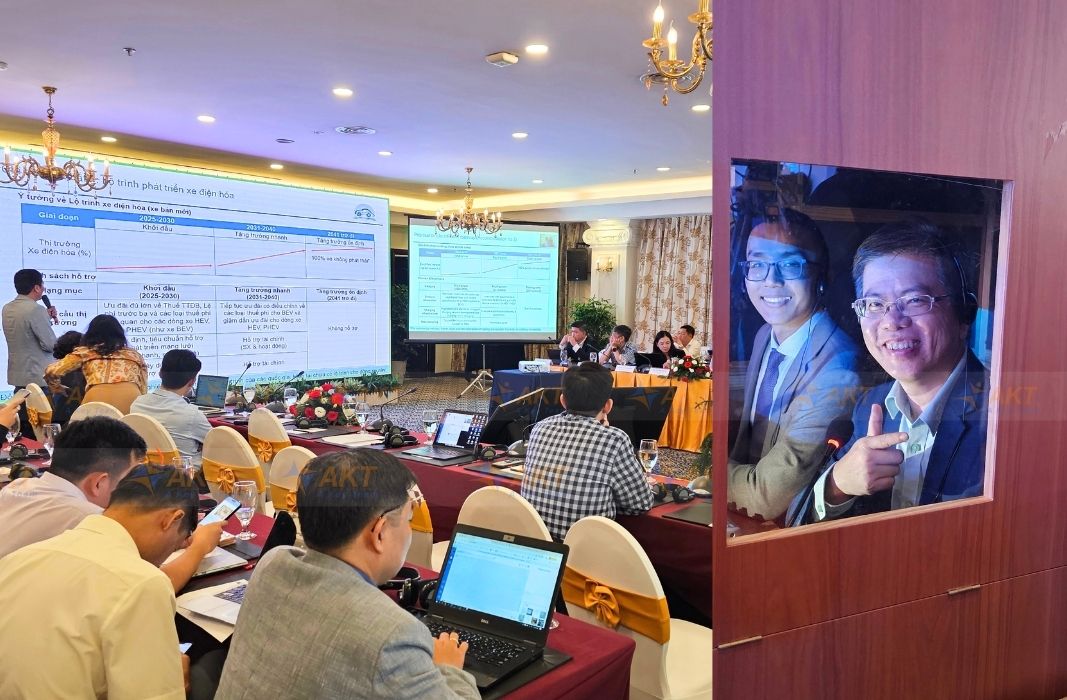
Photo: AKT Translation
The real work happened before the opening remarks: mapping how audio travels from the floor mic into Zoom and back, then a short briefing with the organisers and the speaker on where to click. The best result: she answered every question smoothly, barely aware that anyone was interpreting for her.
More technology behind the scenes should mean less complexity in front of the audience.
How do you handle Q&A with remote speakers at your events? If one is coming up, talk to AKT Translation early.
What the Workshop Covered and Where Interpreting Gets Hard
According to UNDP's press release, the workshop was part of the Climate Promise initiative supported by the Government of Japan, held with the approval of the HCMC People's Committee, in a city of more than 13 million people that relies mainly on private vehicles. Presentations covered four areas: comparing low-emission vehicle technologies, market and charging-infrastructure readiness, user behaviour, and policy mechanisms. UNDP's key message was that "there is no single solution": the transition needs policy, investment and public–private partnership together.
For interpreters, the difficulty is that these four areas collide in a single audience question, delivered over a connection with latency. The table below summarises the two setups:
|
One-way |
Two-way | |
| Remote speaker's role | Presents only | Presents, hears questions, answers |
| Zoom/Teams interpretation feature | Often not needed | Required, one channel per language |
| Audio path | Zoom → hall | Hall ↔ Zoom, including floor mics |
| Typical risks | Lag, dropped connection | Plus echo, wrong channel, questions not reaching the speaker |
If your event also has a remote speaker and live Q&A, AKT Translation can support you from the preparation stage.
The Interpreter's Choices: Two Terms That Are Easy to Get Wrong
- Low-emission vehicle → "phương tiện phát thải thấp" (low-emission), never "xe sạch" (clean car) or "zero-emission". Hybrids still burn fuel; overstating the speaker's claim is a mistranslation, especially at a policy forum.
- Battery swapping → "hoán đổi pin" (a swap-station service model), not "thay pin", which sounds like a repair-shop battery replacement.
Interpreting for Development Partner Events
AKT Translation has also interpreted a public–private partnership (PPP) workshop by the National Innovation Center (NIC) and the Saigon Innovation Hub (SIHUB), where a UNDP expert presented online and the HCMC Department of Science and Technology attended: another policy forum linking an international remote speaker with a live audience.
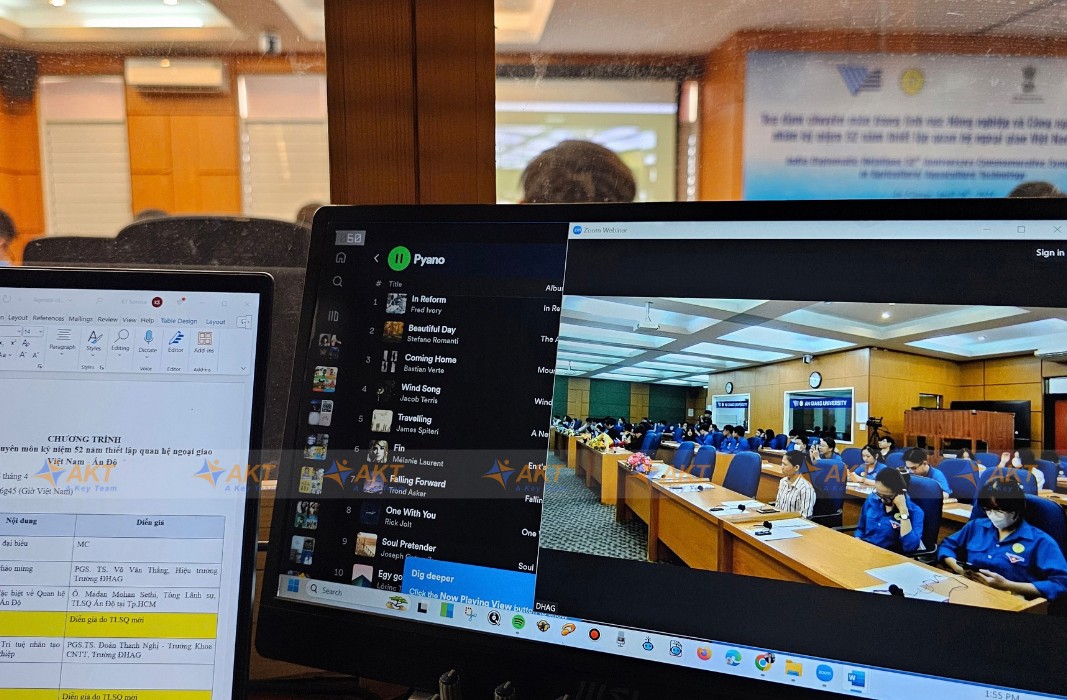
Photo: AKT Translation
For Event Organisers and International Delegations
Many of the sessions we interpret are booked not by the host but by an event organiser, PCO or DMC running a delegation or conference in Vietnam. For these partners, two-way remote sessions are where things usually go wrong, because the venue AV team, the platform host and the interpreters sit in different companies. AKT Translation slots in behind the organiser: we join the technical rehearsal, agree the channel plan with the AV team, brief remote speakers, and keep the client-facing side under the organiser's brand. This works the same for MICE interpreting in Vietnam, from incentive groups and board meetings to hybrid conferences.
Remote Interpretation FAQs
1. Does Zoom have an interpretation feature?
Yes. Zoom Meetings and Zoom Webinars include Language Interpretation on paid plans, enabled in the account settings. The host assigns interpreters and creates language channels; participants click the globe icon to choose a channel. Microsoft Teams offers a similar feature on some plans.
2. How much does remote interpretation cost?
Cost depends on the mode (simultaneous or consecutive), duration, number of languages, subject complexity, one-way or two-way setup, and whether on-site audio coordination is needed. Simultaneous interpretation usually requires two interpreters taking turns. Send your agenda and event duration to AKT Translation for a tailored quote.
3. How do you prepare for a hybrid conference with interpreters?
Share presentations in advance, along with the list of remote speakers and the platform (Zoom or Teams). Run at least one connection test with each remote speaker, set up a private channel between the tech team and interpreters, and agree on a fallback plan if a speaker drops off mid-session.
4. Should interpreters be on site when a speaker joins online?
For hybrid events, yes. Being in the hall lets interpreters hear floor microphones directly, coordinate quickly with the tech team and react immediately if a channel fails. If every speaker and listener is online, remote interpreting is a sensible option.
Planning a conference with remote speakers?
- Advice on one-way or two-way interpretation setups on Zoom and Teams
- Coordination between in-room audio and online platforms
- Experienced interpreters for policy, green transport and MICE events
Get a quote: +84 888 170 069 | Email: info@phiendichvien.com
AKT – Calm interpreting, successful events
----------
Read this article in Vietnamese.
-
 Specialist InterpretingView MoreAs senior managers, we know what attributes our clients are looking for in an interpreter – a good translator with expertise who can process ideas from one language to another professionally. A strong interpreter adds value to any event.
 -
 TranslationView MoreOver the years, we have worked with thousands of high-profile customers, many of whom are impressed by our excellent services.
 -
 TrainingView MoreThe way we teach is characterized by putting trainees at the forefront of the learning process. Our curriculum is open to adaptability and development of personal skills in an approach best described as "From conferences to classrooms".