
Two-Way Simultaneous Interpreting: Fortune Asia × ITPC Forum
Author: Khang Nguyen
Khang Nguyen AKT - English Vietnamese Lead interpreter, 25 years in 5000 events
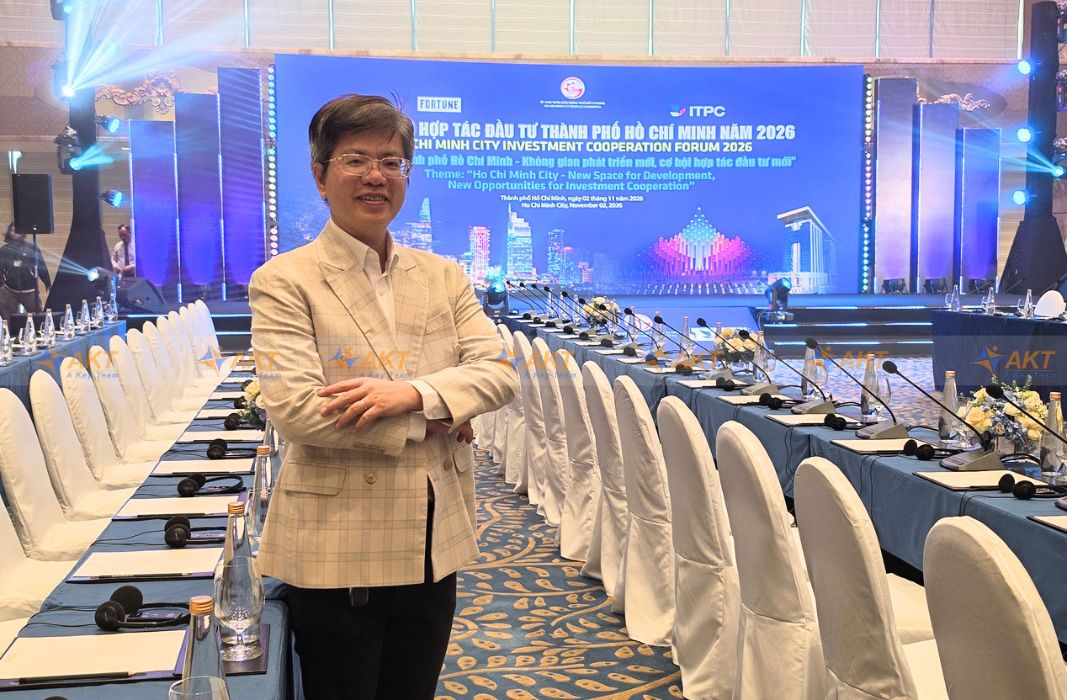
This article shows how two AKT Translation interpreters delivered two-way simultaneous interpreting, English into Vietnamese and back, for a high-level investment forum. The Ho Chi Minh City Investment Cooperation Forum 2026, organised by ITPC and Fortune Asia at The Reverie Saigon, brought together more than 100 business and association leaders (Vietnam News Agency).
The moment I remember most did not happen in the booth. It came earlier, while I was reading the documents the organisers had sent and saw two words: Fortune Asia. For as long as I can remember, Fortune had been a masthead on a newsstand and a set of company rankings. Here it appeared as something else entirely: a platform that brings a city's leadership and the region's corporations to the same table. Seeing is believing; this time I got to voice it. That afternoon, the words of city leaders and of senior executives from the Fortune network passed through our voices on their way to the other side of the room, and I felt grateful that AKT Translation was sitting right at the centre of it.
What the forum covered and where interpreting gets hard
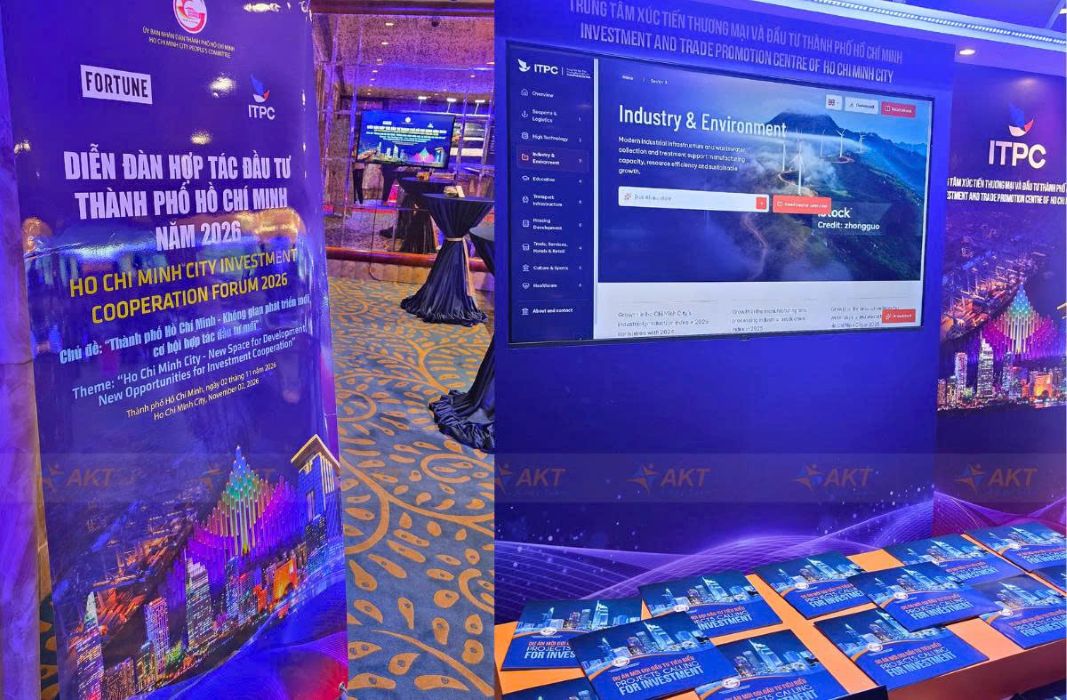
According to Bao Dau Tu newspaper, the Ho Chi Minh City Investment Cooperation Forum 2026 was co-organised by the Investment and Trade Promotion Centre of Ho Chi Minh City (ITPC) and Fortune Asia, timed with Fortune's choice of the city to host its first Fortune Southeast Asia 500 Summit (Saigon Giai Phong newspaper). The Standing Vice Chairman of the HCMC People's Committee chaired the forum. Fortune Asia's Editorial Director spoke, ITPC presented the city's investment opportunities, and representatives of AmCham Vietnam, SingCham and SCG shared their investment journeys before an open dialogue with investors.
Listening from the booth as foreign participants put their questions to the city leaders chairing the forum, one thing became clear to me: they genuinely value the Vietnamese market.
Three things made the afternoon demanding. First, the figures came thick and fast, such as USD 19.1 billion in FDI over ten months (Vietnam News Agency). Second, the dialogue switched direction constantly: investors asked in English, the city answered in Vietnamese, and the next question followed straight away. Third, investment language carries legal weight yet has to sound natural to an international ear. Simultaneous interpreting at The Reverie Saigon that day relied on careful preparation, not reflexes alone.
If your event is just as dialogue-heavy, AKT Translation can help you plan the booth from the moment the agenda is set.
Why one booth needs two interpreters who work both ways
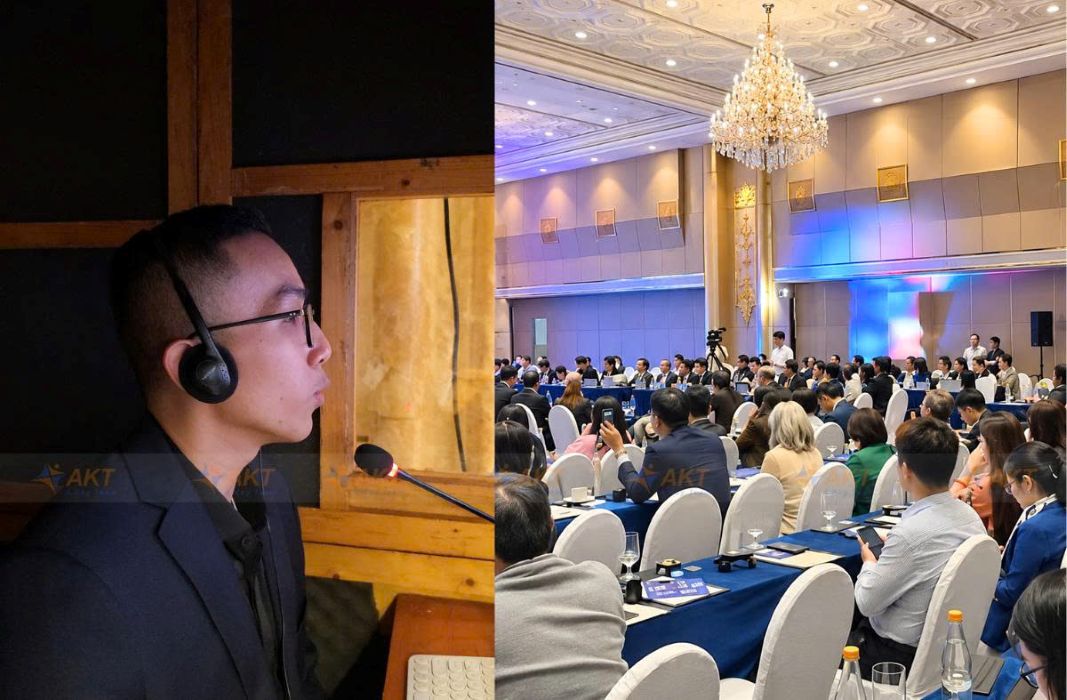
A simultaneous session of several hours is never a one-person job. At this forum, Thinh and I rotated roughly every 15 to 20 minutes. More importantly, both of us work English into Vietnamese and Vietnamese into English, so when the dialogue changed speaker, whoever held the microphone simply carried on, with no handover mid-sentence.
The feedback we treasure came from the foreign speakers. They told us that in many countries they are used to one interpreter per direction, yet here both interpreters handled both directions and still sounded smooth, pleasant and easy to follow.
One interpreter per direction remains a common and perfectly sound set-up for many events. For a forum built on back-and-forth questions, however, a team that covers both directions keeps the channel seamless.
Investment forum terms that trip up literal translation
Green channel → "luồng xanh" (priority lane), not "kênh xanh": in customs and administrative procedures, a green channel is a fast-track route with fewer checks for eligible files. "Kênh xanh" sounds like a TV channel to Vietnamese listeners.
Sandbox → "cơ chế thử nghiệm có kiểm soát" (a controlled testing mechanism), not "hộp cát": a sandbox lets new models such as digital finance be piloted within set limits and timeframes.
For event organisers planning business delegations to Vietnam
Many international forums and business missions to Vietnam are booked through an event management company, PCO or DMC rather than by the delegation itself. For organisers in Singapore and across the region, a local interpreting partner should cover the whole brief: English–Vietnamese simultaneous and consecutive teams in Ho Chi Minh City, Hanoi and the provinces; on-site, online and hybrid set-ups; a briefing and rehearsal with your team; and a quote built from your agenda. AKT Translation works in exactly this way, so your client meets the city, and the city meets your client, in their own language.
Interpreting for investment promotion forums
That impression matches what the AKT Translation team has seen lately. Many events are now taking place in Ho Chi Minh City for the first time, and some conference centres have opened in places I never expected to find one. Travelling across Vietnam, the team keeps meeting new conference venues, and has interpreted at the opening events of quite a few of them. Looking back, it makes me glad: this is more than an ordinary job, because we get to witness and experience so much that is new. Seeing what is interesting, though, takes a certain frame of mind.
Before this forum, the team interpreted for ITPC at a supporting industries seminar, and also worked the booth at the Ho Chi Minh City Logistics Forum.
Frequently asked questions
What is simultaneous interpreting?
Simultaneous interpreting means the interpreter works from a soundproof booth and speaks the translation almost at the same time as the speaker. Listeners choose their language channel on wireless headsets, so the programme keeps its original length.
How do event organisers book interpreters in Vietnam?
Most organisers book through a local interpreting provider several weeks ahead. Share the agenda, venue, expected audience and language pairs; the provider proposes the interpreting mode, team size and equipment. Confirm a briefing call and a sound check, and send speeches and slides as soon as they are ready.
How much does English–Vietnamese simultaneous interpreting cost?
Cost depends on session length (half or full day), subject complexity, the number of language pairs, how many listeners need headsets, and the venue. Booth equipment is usually quoted separately from interpreters. The quickest route is to send your agenda and duration to AKT Translation for a tailored quote.
What should we send interpreters before the event?
Send the programme, speeches, slides and the list of speakers with their titles as early as possible, ideally several days ahead. A short briefing with the interpreters and a sound check before the opening help prevent avoidable problems on the day. For Q&A sessions, questions submitted in advance are also useful.
Planning an event or delegation in Vietnam for your client?
✓ Advice on booth set-up and listening channels
✓ Professional interpreting equipment
✓ Interpreters experienced in investment forums, trade promotion and high-level conferences
Get a quote: +84 888 170 069 | Email: info@phiendichvien.com
AKT – Calm voices. Successful events.
------------
Read this article in Vietnamese
-
 Specialist InterpretingView MoreAs senior managers, we know what attributes our clients are looking for in an interpreter – a good translator with expertise who can process ideas from one language to another professionally. A strong interpreter adds value to any event.
-
 TranslationView MoreOver the years, we have worked with thousands of high-profile customers, many of whom are impressed by our excellent services.
-
 TrainingView MoreThe way we teach is characterized by putting trainees at the forefront of the learning process. Our curriculum is open to adaptability and development of personal skills in an approach best described as "From conferences to classrooms".